Design Thinking Fundamentals
Design Thinking Fundamentals
Designing a Video-First Micro-Course for Business Professionals
Designing a Video-First Micro-Course for Business Professionals
A standalone LXD portfolio project demonstrating end-to-end instructional design — from learning objective development through video production, interactive build, and assessment design.
A standalone LXD portfolio project demonstrating end-to-end instructional design — from learning objective development through video production, interactive build, and assessment design.
Company
Company
LXD Portfolio Project
Livetime
Services
Services
Instructional Design, Video Production, UI Development
Instructional Design, Video Production, UI Development
Frameworks
Frameworks
Knowles' Andragogy, Gagne's Nine Events, Bloom's Taxonomy
Knowles' Andragogy, Gagne's Nine Events, Bloom's Taxonomy
Duration
Duration
2026
2026
Try it out:
Click here to view on a different tab
Try it out:
Click here to view on a different tab
PROBLEM
PROBLEM
Most design thinking resources fail learners in one of two ways:
They are too theoretical — long articles and academic frameworks that stay in the head, not the hands
They are too surface-level — one-slide summaries that create awareness but not behavior change
Neither format builds the kind of durable learning that actually changes how someone approaches a problem
Insight: Learners don't need more information about design thinking. They need a structured experience that moves them from understanding to application — in the time they actually have.
Most design thinking resources fail learners in one of two ways:
They are too theoretical — long articles and academic frameworks that stay in the head, not the hands
They are too surface-level — one-slide summaries that create awareness but not behavior change
Neither format builds the kind of durable learning that actually changes how someone approaches a problem
Insight: Learners don't need more information about design thinking.They need a structured experience that moves them from understanding to application — in the time they actually have.
Most design thinking resources fail learners in one of two ways:
They are too theoretical — long articles and academic frameworks that stay in the head, not the hands
They are too surface-level — one-slide summaries that create awareness but not behavior change
Neither format builds the kind of durable learning that actually changes how someone approaches a problem
Insight: Learners don't need more information about design thinking. They need a structured experience that moves them from understanding to application — in the time they actually have.
APPROACH
APPROACH
I reframed the product around a core question:
“How might we design a short course that actually changes how someone approaches a problem?”
This led to exploring:
Knowles' Andragogy — leading with relevance and professional context before content
Gagne's Nine Events — structuring each module as a complete instructional sequence
Bloom's Taxonomy — moving learners from understanding to application within each lesson
Cognitive Load Theory — chunking content and delivering multimodally to reduce cognitive effort
Scenario-Based Learning — anchoring all activities to a single recurring professional character (Maya)
Retrieval Practice — ending each module with a knowledge check that forces active recall
I reframed the project around a core question:
"How might we design a 15-minute course that actually changes how someone approaches a problem — not just what they know about the methodology?"
This led to exploring:
Knowles' Andragogy — leading with relevance and professional context before content
Gagne's Nine Events — structuring each module as a complete instructional sequence
Bloom's Taxonomy — moving learners from understanding to application within each lesson
Cognitive Load Theory — chunking content and delivering multimodally to reduce cognitive effort
Scenario-Based Learning — anchoring all activities to a single recurring professional character (Maya)
Retrieval Practice — ending each module with a knowledge check that forces active recall
SOLUTION
The result is a three-module, video-first interactive micro-course built in Lovable, with ElevenLabs voiceover, Jitter motion graphics, and a completion certificate:
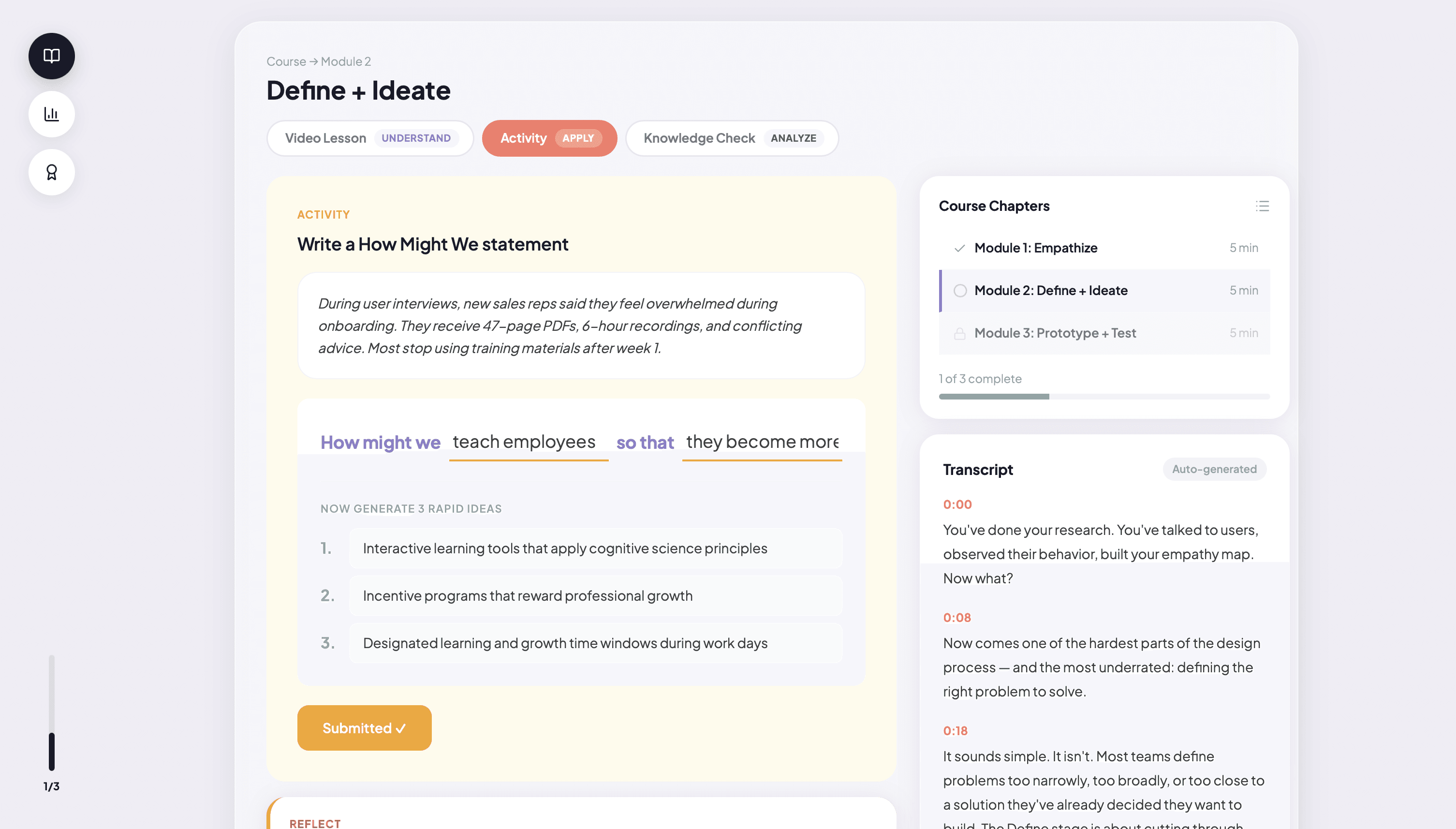
Module 1: Empathize — video lesson, empathy map activity, 3-question knowledge check
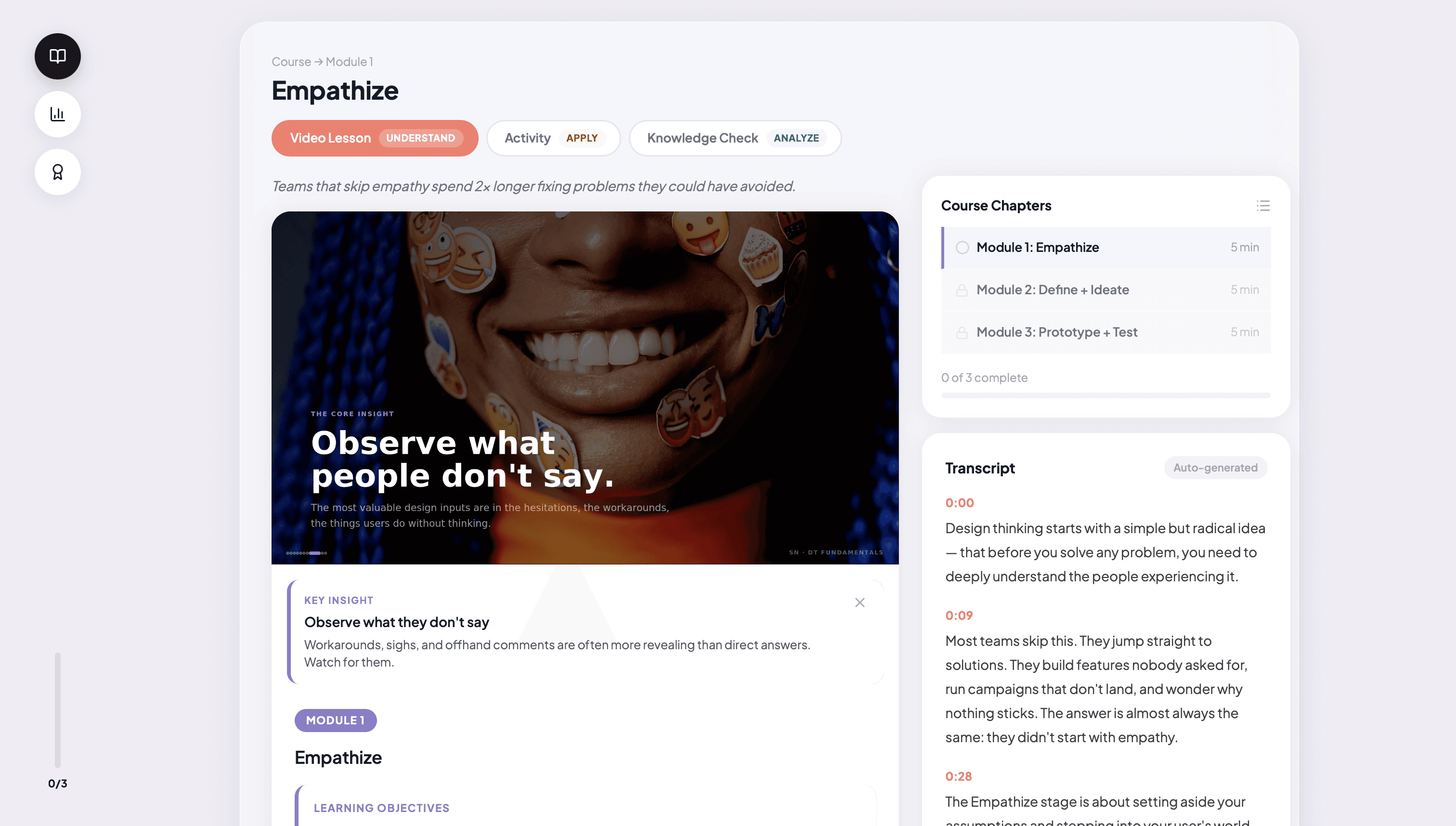
Module 2: Define + Ideate — video lesson, HMW builder activity, 3-question knowledge check
Module 3: Prototype + Test — video lesson, prototype matching activity, 3-question knowledge check
Each module tab is labeled with its Bloom's level — Understand, Apply, Analyze — making the instructional intent visible to the learner. A synchronized transcript runs alongside every video. Modules unlock sequentially. The certificate reflects actual quiz performance, not just completion.
IMPACT
A fully interactive, responsive micro-course deployable as a live URL
30 slide assets produced at 1920x1080 across 10 slide types — editorial, cinematic, stat, split, photo, and text
Three AI-generated voiceover scripts recorded and synced to video
One learning artifact demonstrating end-to-end LXD capability for a GTM enablement context
(Live demo available at salmanurse.com/lxd)
[Image: App screenshot — certificate screen or empathy map activity]
...what this case study does not show
This project was built as a portfolio artifact, not a commissioned product. As a result this page omits:
Learner performance data and quiz completion rates
A/B testing across instructional formats
Stakeholder iteration and revision cycles
LET'S CHAT
Request a Walkthrough
This case study is best experienced as a live demo of the interactive course.
In a walkthrough, I can share:
Full module flow and instructional design decisions
Before/after comparisons of slide types and activity formats
Trade-offs between LXD frameworks and practical time constraints
How adult learning principles were made visible in the UI
Happy to walk through this project in detail during an interview.
REFLECTION
What I learned
Building Design Thinking Fundamentals reinforced a shift from content creation to learning design:
Relevance before content Adults disengage before they even start if the "why" isn't answered first. Leading with credibility (IDEO, Google, Apple) and a clear outcome before any instruction changed how the course felt from the opening screen.
Scenario continuity reduces cognitive re-entry costs Keeping Maya as the recurring character across all three modules meant learners spent less mental energy re-establishing context and more energy applying the framework.
Multimodal delivery is accessibility, not decoration Video plus synchronized transcript is not redundancy — it serves auditory learners, visual readers, and non-native English speakers simultaneously.
The activity is where learning actually happens Video creates understanding. The empathy map, HMW builder, and prototype matching activities are where learners internalize the methodology. The quiz just confirms it.
AI tools are a legitimate production asset, not a shortcut ElevenLabs, Jitter, Higgsfield, and Lovable reduced production time significantly while maintaining quality. Being fluent in these tools is now table stakes for LXD at scale.
[Go back ↑]
This maps exactly to the LiveTime layout: title, subtitle, intro, metadata row, hero, PROBLEM, image, APPROACH, SOLUTION, IMPACT, image, transparency section, LET'S CHAT, REFLECTION. Ready to drop directly into Framer. Want the cover letter next?
I reframed the product around a core question:
“How might we design a short course that actually changes how someone approaches a problem?”
This led to exploring:
Gagne's Nine Events — structuring each module as a complete instructional sequence
Bloom's Taxonomy — moving learners from understanding to application within each lesson
Cognitive Load Theory — chunking content and delivering multimodally to reduce cognitive effort
Scenario-Based Learning — anchoring all activities to a single recurring professional character (Maya)
Retrieval Practice — ending each module with a knowledge check that forces active recall
Knowles' Andragogy — leading with relevance and professional context before content
I reframed the product around a core question:
“How might we design a short course that actually changes how someone approaches a problem?”
This led to exploring:
Knowles' Andragogy — leading with relevance and professional context before content
Gagne's Nine Events — structuring each module as a complete instructional sequence
Bloom's Taxonomy — moving learners from understanding to application within each lesson
Cognitive Load Theory — chunking content and delivering multimodally to reduce cognitive effort
Scenario-Based Learning — anchoring all activities to a single recurring professional character (Maya)
Retrieval Practice — ending each module with a knowledge check that forces active recall
I reframed the project around a core question:
"How might we design a 15-minute course that actually changes how someone approaches a problem — not just what they know about the methodology?"
This led to exploring:
Knowles' Andragogy — leading with relevance and professional context before content
Gagne's Nine Events — structuring each module as a complete instructional sequence
Bloom's Taxonomy — moving learners from understanding to application within each lesson
Cognitive Load Theory — chunking content and delivering multimodally to reduce cognitive effort
Scenario-Based Learning — anchoring all activities to a single recurring professional character (Maya)
Retrieval Practice — ending each module with a knowledge check that forces active recall
SOLUTION
The result is a three-module, video-first interactive micro-course built in Lovable, with ElevenLabs voiceover, Jitter motion graphics, and a completion certificate:
Module 1: Empathize — video lesson, empathy map activity, 3-question knowledge check
Module 2: Define + Ideate — video lesson, HMW builder activity, 3-question knowledge check
Module 3: Prototype + Test — video lesson, prototype matching activity, 3-question knowledge check
Each module tab is labeled with its Bloom's level — Understand, Apply, Analyze — making the instructional intent visible to the learner. A synchronized transcript runs alongside every video. Modules unlock sequentially. The certificate reflects actual quiz performance, not just completion.
IMPACT
A fully interactive, responsive micro-course deployable as a live URL
30 slide assets produced at 1920x1080 across 10 slide types — editorial, cinematic, stat, split, photo, and text
Three AI-generated voiceover scripts recorded and synced to video
One learning artifact demonstrating end-to-end LXD capability for a GTM enablement context
(Live demo available at salmanurse.com/lxd)
[Image: App screenshot — certificate screen or empathy map activity]
...what this case study does not show
This project was built as a portfolio artifact, not a commissioned product. As a result this page omits:
Learner performance data and quiz completion rates
A/B testing across instructional formats
Stakeholder iteration and revision cycles
LET'S CHAT
Request a Walkthrough
This case study is best experienced as a live demo of the interactive course.
In a walkthrough, I can share:
Full module flow and instructional design decisions
Before/after comparisons of slide types and activity formats
Trade-offs between LXD frameworks and practical time constraints
How adult learning principles were made visible in the UI
Happy to walk through this project in detail during an interview.
REFLECTION
What I learned
Building Design Thinking Fundamentals reinforced a shift from content creation to learning design:
Relevance before content Adults disengage before they even start if the "why" isn't answered first. Leading with credibility (IDEO, Google, Apple) and a clear outcome before any instruction changed how the course felt from the opening screen.
Scenario continuity reduces cognitive re-entry costs Keeping Maya as the recurring character across all three modules meant learners spent less mental energy re-establishing context and more energy applying the framework.
Multimodal delivery is accessibility, not decoration Video plus synchronized transcript is not redundancy — it serves auditory learners, visual readers, and non-native English speakers simultaneously.
The activity is where learning actually happens Video creates understanding. The empathy map, HMW builder, and prototype matching activities are where learners internalize the methodology. The quiz just confirms it.
AI tools are a legitimate production asset, not a shortcut ElevenLabs, Jitter, Higgsfield, and Lovable reduced production time significantly while maintaining quality. Being fluent in these tools is now table stakes for LXD at scale.
[Go back ↑]
This maps exactly to the LiveTime layout: title, subtitle, intro, metadata row, hero, PROBLEM, image, APPROACH, SOLUTION, IMPACT, image, transparency section, LET'S CHAT, REFLECTION. Ready to drop directly into Framer. Want the cover letter next?
SOLUTION
SOLUTION
The result is a three-module, video-first interactive micro-course built in Lovable, with ElevenLabs voiceover, Jitter motion graphics, and a completion certificate:
Module 1: Empathize — video lesson, empathy map activity, 3-question knowledge check
Module 2: Define + Ideate — video lesson, HMW builder activity, 3-question knowledge check
Module 3: Prototype + Test — video lesson, prototype matching activity, 3-question knowledge check
Each module tab is labeled with its Bloom's level — Understand, Apply, Analyze — making the instructional intent visible to the learner. A synchronized transcript runs alongside every video. Modules unlock sequentially. The certificate reflects actual quiz performance, not just completion.
Without exposing proprietary details, the redesign focused on:
A personalized time-based system that unifies events and availability
A streamlined scheduling experience that prioritizes clarity over volume
A more intuitive discovery layer aligned with user context and group activity
These changes shifted the experience from fragmented tools to a cohesive, action-oriented flow.
IMPACT
IMPACT
A fully interactive, responsive micro-course deployable as a live URL
30 slide assets produced at 1920x1080 across 10 slide types — editorial, cinematic, stat, split, photo, and text
Three AI-generated voiceover scripts recorded and synced to video
One learning artifact demonstrating end-to-end LXD capability for a GTM enablement context
A fully interactive, responsive micro-course deployable as a live URL
30 slide assets produced at 1920x1080 across 10 slide types — editorial, cinematic, stat, split, photo, and text
Three AI-generated voiceover scripts recorded and synced to video
One learning artifact demonstrating end-to-end LXD capability for a GTM enablement context
REFLECTION
REFLECTION
What I learned
What I learned
Building Design Thinking Fundamentals reinforced a shift from content creation to learning design:
Relevance before content Adults disengage before they even start if the "why" isn't answered first. Leading with credibility (IDEO, Google, Apple) and a clear outcome before any instruction changed how the course felt from the opening screen.
Scenario continuity reduces cognitive re-entry costs Keeping Maya as the recurring character across all three modules meant learners spent less mental energy re-establishing context and more energy applying the framework.
Multimodal delivery is accessibility, not decoration Video plus synchronized transcript is not redundancy — it serves auditory learners, visual readers, and non-native English speakers simultaneously.
The activity is where learning actually happens Video creates understanding. The empathy map, HMW builder, and prototype matching activities are where learners internalize the methodology. The quiz just confirms it.
AI tools are a legitimate production asset, not a shortcut ElevenLabs, Jitter, Higgsfield, and Lovable reduced production time significantly while maintaining quality. Being fluent in these tools is now table stakes for LXD at scale.
Building Design Thinking Fundamentals reinforced a shift from content creation to learning design:
Relevance before content Adults disengage before they even start if the "why" isn't answered first. Leading with credibility (IDEO, Google, Apple) and a clear outcome before any instruction changed how the course felt from the opening screen.
Scenario continuity reduces cognitive re-entry costs Keeping Maya as the recurring character across all three modules meant learners spent less mental energy re-establishing context and more energy applying the framework.
Multimodal delivery is accessibility, not decoration Video plus synchronized transcript is not redundancy — it serves auditory learners, visual readers, and non-native English speakers simultaneously.
The activity is where learning actually happens Video creates understanding. The empathy map, HMW builder, and prototype matching activities are where learners internalize the methodology. The quiz just confirms it.
AI tools are a legitimate production asset, not a shortcut ElevenLabs, Jitter, Higgsfield, and Lovable reduced production time significantly while maintaining quality. Being fluent in these tools is now table stakes for LXD at scale.