Livetime
Livetime
Improving Group Coordination & Event Engagement
Improving Group Coordination & Event Engagement
Livetime is a social event platform designed for student communities to organize, discover, and attend events together. I worked as a UX/UI Designer to improve how users coordinate availability, discover events, and stay engaged within groups.
Due to NDA constraints, some visuals and metrics are simplified or anonymized.
Livetime is a social event platform designed for student communities to organize, discover, and attend events together. I worked as a UX/UI Designer to improve how users coordinate availability, discover events, and stay engaged within groups.
Due to NDA constraints, some visuals and metrics are simplified or anonymized.
Company
Company
Livetime
Livetime
Services
Services
Web Design
UI & UX Design
Web Design
UI & UX Design
Industries
Industries
Event Management
Event Management
Duration
Duration
Jun 2025- Feb 2026
Jun 2025- Feb 2026
PROBLEM
PROBLEM
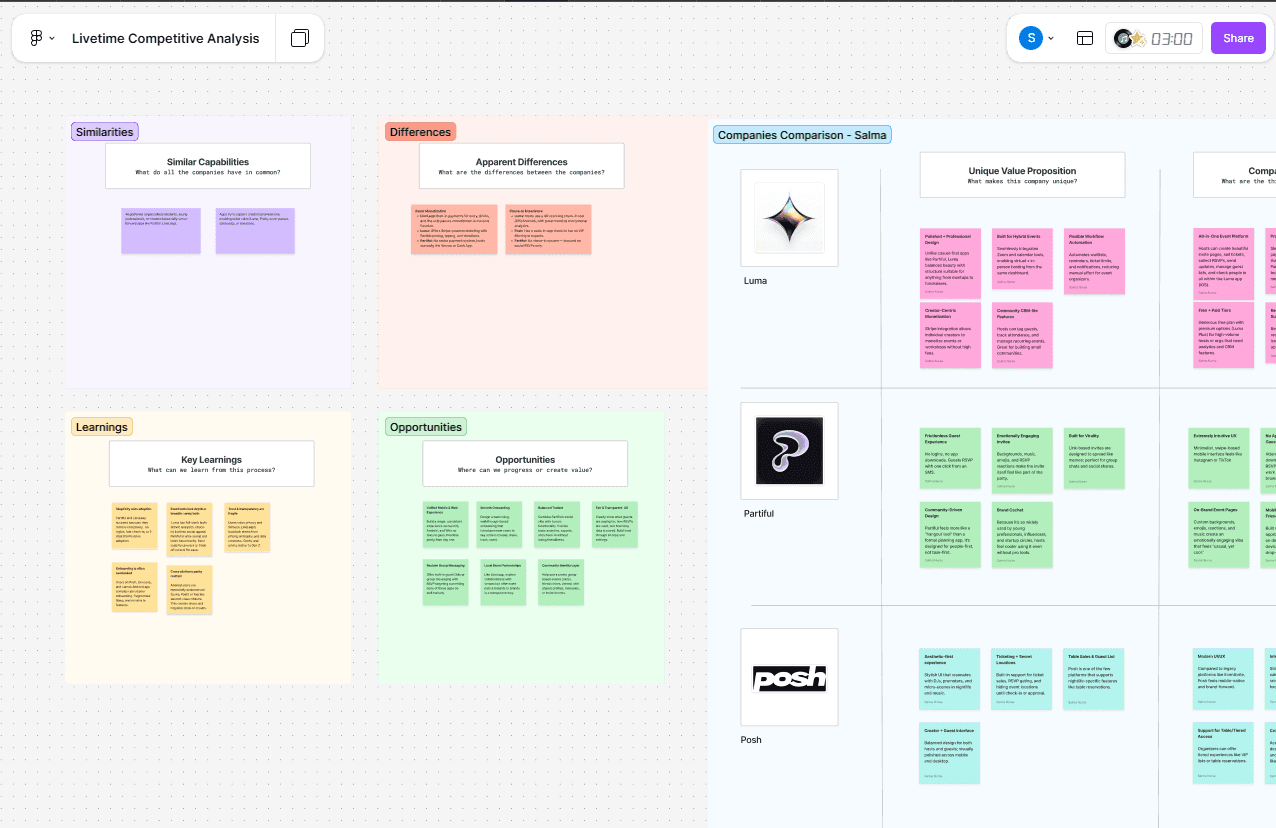
Planning within groups was fragmented and inefficient:
Users relied on multiple tools to coordinate (messaging, polls, calendars)
Availability inputs were overwhelming and often ignored
Event discovery felt disconnected from actual user intent
Insight:
Users don’t think in tools—they think in time, plans, and people.
Planning within groups was fragmented and inefficient:
Users relied on multiple tools to coordinate (messaging, polls, calendars)
Availability inputs were overwhelming and often ignored
Event discovery felt disconnected from actual user intent
Insight:
Users don’t think in tools—they think in time, plans, and people.
APPROACH
APPROACH
I reframed the product around a core question:
“How might we make group coordination feel effortless and intuitive?”
This led to exploring:
Time as the central organizing principle
Reducing decision fatigue in scheduling
Designing for shared behavior instead of individual actions
I reframed the product around a core question:
“How might we make group coordination feel effortless and intuitive?”
This led to exploring:
Time as the central organizing principle
Reducing decision fatigue in scheduling
Designing for shared behavior instead of individual actions
I reframed the product around a core question:
“How might we make group coordination feel effortless and intuitive?”
This led to exploring:
Time as the central organizing principle
Reducing decision fatigue in scheduling
Designing for shared behavior instead of individual actions
Time as the central organizing principle
Time as the central organizing principle
Designing for shared behavior instead of individual actions
Designing for shared behavior instead of individual actions
Designing for shared behavior instead of individual actions
Reducing decision fatigue in scheduling
Reducing decision fatigue in scheduling
SOLUTION (HIGH LEVEL)
SOLUTION (HIGH LEVEL)
Without exposing proprietary details, the redesign focused on:
A personalized time-based system that unifies events and availability
A streamlined scheduling experience that prioritizes clarity over volume
A more intuitive discovery layer aligned with user context and group activity
These changes shifted the experience from fragmented tools to a cohesive, action-oriented flow.
Without exposing proprietary details, the redesign focused on:
A personalized time-based system that unifies events and availability
A streamlined scheduling experience that prioritizes clarity over volume
A more intuitive discovery layer aligned with user context and group activity
These changes shifted the experience from fragmented tools to a cohesive, action-oriented flow.
IMPACT
IMPACT
Increased clarity in group coordination
Reduced friction in scheduling and decision-making
Stronger engagement with events and group interactions
(Specific metrics and flows available in a live walkthrough.)
Increased clarity in group coordination
150% retention increase in user retention after onboarding
Reduced friction in scheduling and decision-making
Stronger engagement with events and group interactions
(Specific metrics and flows available in a live walkthrough.)
…what this case study does not show
…what this case study does not show
…what this case study does not show
To respect product confidentiality, this page omits:
Full user flows and interaction patterns
Detailed UI screens and system logic
Internal metrics and experimentation results
To respect product confidentiality, this page omits:
Full user flows and interaction patterns
Detailed UI screens and system logic
Internal metrics and experimentation results
LET'S CHAT
LET'S CHAT
Request a Walkthrough
Request a Walkthrough
Request a Walkthrough
This case study is best experienced as a guided demo.
In a live walkthrough, I can share:
End-to-end flows and design decisions
Before/after comparisons and iterations
Trade-offs, constraints, and product strategy
How design translated into shipped features
Happy to walk through this project in detail during an interview.
This case study is best experienced as a guided demo.
In a live walkthrough, I can share:
End-to-end flows and design decisions
Before/after comparisons and iterations
Trade-offs, constraints, and product strategy
How design translated into shipped features
Happy to walk through this project in detail during an interview.
This case study is best experienced as a guided demo.
In a live walkthrough, I can share:
End-to-end flows and design decisions
Before/after comparisons and iterations
Trade-offs, constraints, and product strategy
How design translated into shipped features
Happy to walk through this project in detail during an interview.
REFLECTION
REFLECTION
What I learned
What I learned
Designing for LiveTime reinforced a shift from feature-based thinking to systems thinking:
Users prioritize outcomes, not tools
People don’t think in “polls” or “calendars”—they think in plans. Designing around time and intent led to more intuitive solutions than adding features.Constraint improves decision-making
Limiting options (e.g., fewer time slots, smarter defaults) reduced cognitive load and helped groups reach decisions faster.Group dynamics require different UX than individual workflows
Designing for multiple users introduced complexity around fairness, visibility, and coordination that doesn’t exist in solo experiences.Clarity in systems is more valuable than flexibility
Overly flexible scheduling created friction. Structured, guided interactions led to better engagement.Strong design communication is critical for execution
Precise specs, clear logic, and alignment with developers ensured that complex interactions translated accurately into the final product.Engagement is driven by momentum, not just access
Making it easy to see, join, and act on events in one flow increased participation more than simply surfacing more options.
Designing for LiveTime reinforced a shift from feature-based thinking to systems thinking:
Users prioritize outcomes, not tools
People don’t think in “polls” or “calendars”—they think in plans. Designing around time and intent led to more intuitive solutions than adding features.Constraint improves decision-making
Limiting options (e.g., fewer time slots, smarter defaults) reduced cognitive load and helped groups reach decisions faster.Group dynamics require different UX than individual workflows
Designing for multiple users introduced complexity around fairness, visibility, and coordination that doesn’t exist in solo experiences.Clarity in systems is more valuable than flexibility
Overly flexible scheduling created friction. Structured, guided interactions led to better engagement.Strong design communication is critical for execution
Precise specs, clear logic, and alignment with developers ensured that complex interactions translated accurately into the final product.Engagement is driven by momentum, not just access
Making it easy to see, join, and act on events in one flow increased participation more than simply surfacing more options.