OVERVIEW
OVERVIEW
What does it take to build a food system that actually works for the students it's supposed to serve?
What does it take to build a food system that actually works for the students it's supposed to serve?
What does it take to build a food system that actually works for the students it's supposed to serve?
As a team of 3, our goal was to design and launch a stigma-free food marketplace for college students — in a semester. Built and shipped using Lovable — designing the full product experience while using AI to accelerate development from concept to live app.
As a team of 3, our goal was to design and launch a stigma-free food marketplace for college students — in a semester. Built and shipped using Lovable — designing the full product experience while using AI to accelerate development from concept to live app.
As a team of 3, our goal was to design and launch a stigma-free food marketplace for college students — in a semester. Built and shipped using Lovable — designing the full product experience while using AI to accelerate development from concept to live app.
Research & Discovery
Going deep on how students experience food insecurity — and why existing systems fail them.
Research & Discovery
Going deep on how students experience food insecurity — and why existing systems fail them.
Research & Discovery
Going deep on how students experience food insecurity — and why existing systems fail them.
Systems Design
Building a three-sided marketplace that works for students, restaurants, and sponsors simultaneously.
Systems Design
Building a three-sided marketplace that works for students, restaurants, and sponsors simultaneously.
Systems Design
Building a three-sided marketplace that works for students, restaurants, and sponsors simultaneously.
Launch & Validation
Piloting at UB and collecting the data that proves the model works.
Launch & Validation
Piloting at UB and collecting the data that proves the model works.
Launch & Validation
Piloting at UB and collecting the data that proves the model works.
PROBLEM
PROBLEM
PROBLEM
There's food. There is willingness to give. The system does not allow it.
There's food. There is willingness to give. The system does not allow it.
There's food. There is willingness to give. The system does not allow it.
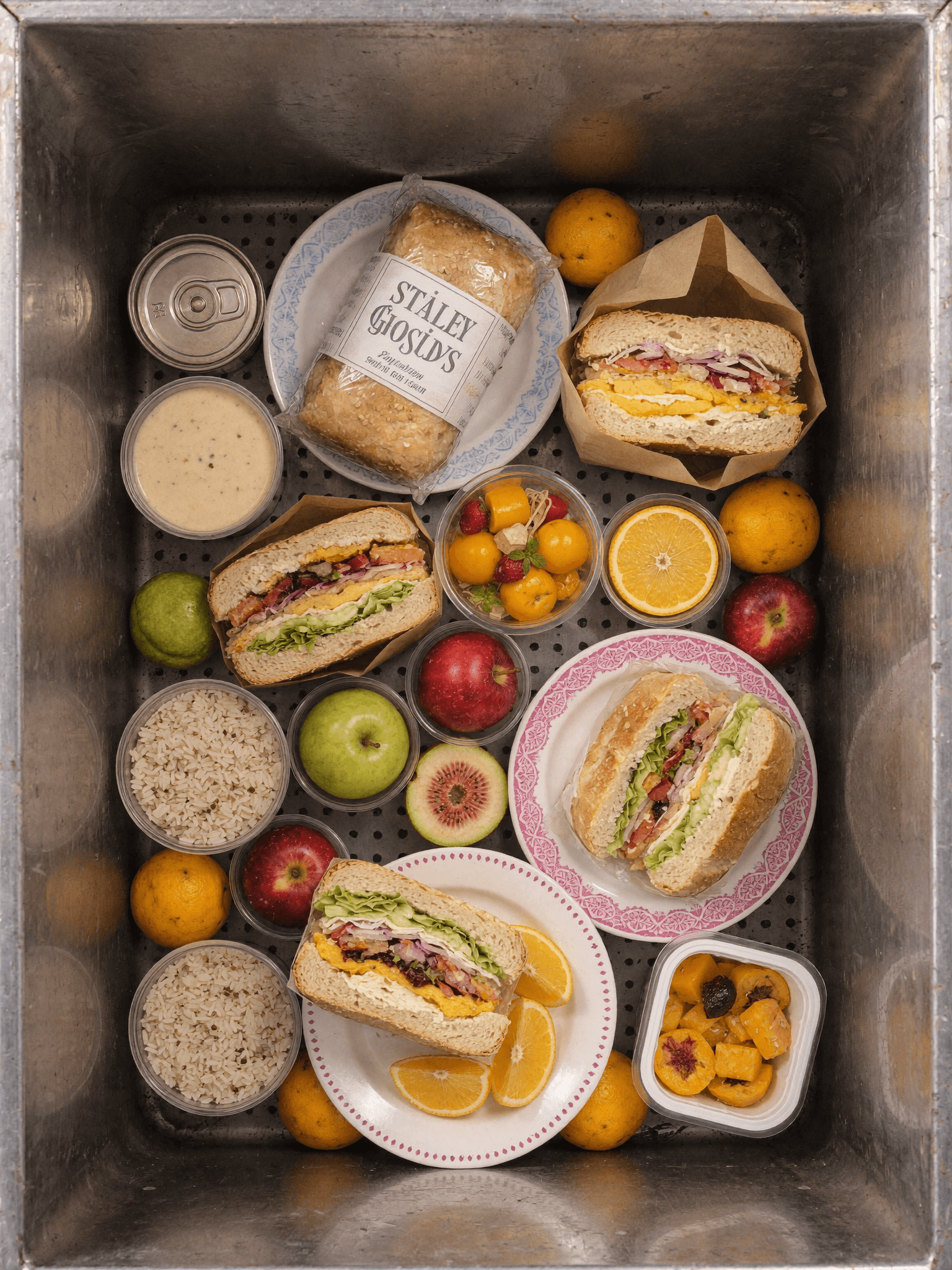
1 in 3 college students experiences food insecurity. Universities across the U.S. throw away 22 million pounds of food every year. At the University at Buffalo specifically — 53% of students face food insecurity, 27% link it directly to academic decline, and 34% of college dropouts nationally cite not having enough money for food and rent. The resources exist. The need exists. Nothing connects them.
1 in 3 college students experiences food insecurity. Universities across the U.S. throw away 22 million pounds of food every year. At the University at Buffalo specifically — 53% of students face food insecurity, 27% link it directly to academic decline, and 34% of college dropouts nationally cite not having enough money for food and rent. The resources exist. The need exists. Nothing connects them.
1 in 3 college students experiences food insecurity. Universities across the U.S. throw away 22 million pounds of food every year. At the University at Buffalo specifically — 53% of students face food insecurity, 27% link it directly to academic decline, and 34% of college dropouts nationally cite not having enough money for food and rent. The resources exist. The need exists. Nothing connects them.
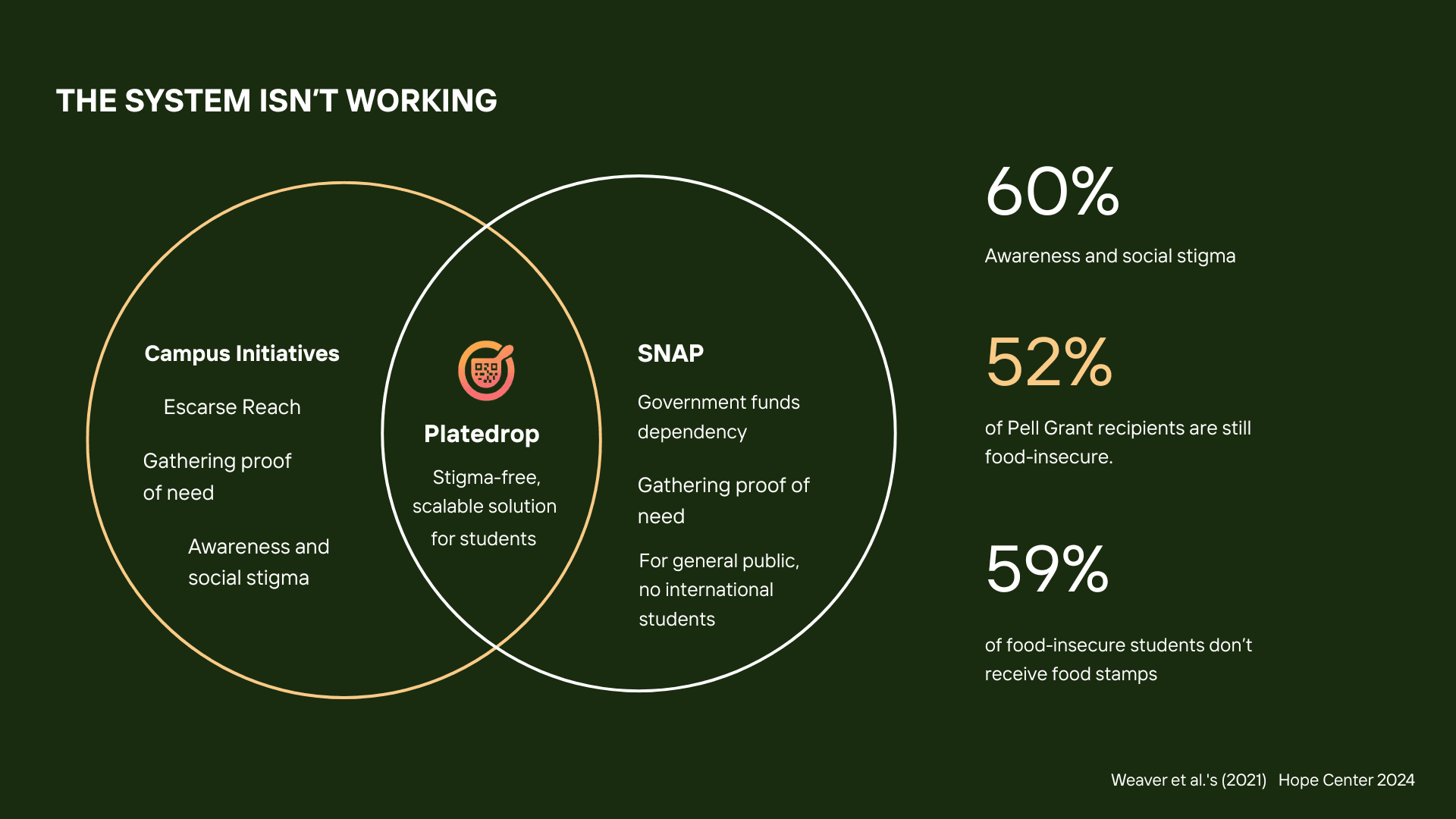
SNAP doesn't reach them.
59% of food-insecure students don't receive food stamps. 52% of Pell Grant recipients are still food insecure. The programs built to help students were built for the general public — not for someone who has 1hr 30min of work-study wages to cover a $24 dinner.
SNAP doesn't reach them.
59% of food-insecure students don't receive food stamps. 52% of Pell Grant recipients are still food insecure. The programs built to help students were built for the general public — not for someone who has 1hr 30min of work-study wages to cover a $24 dinner.
SNAP doesn't reach them.
59% of food-insecure students don't receive food stamps. 52% of Pell Grant recipients are still food insecure. The programs built to help students were built for the general public — not for someone who has 1hr 30min of work-study wages to cover a $24 dinner.
Campus initiatives don't scale.
Scarce reach. Proof-of-need requirements. Awareness and social stigma that stops students from using the pantry even when they know it exists — 66% know about it. They just won't walk in.
Campus initiatives don't scale.
Scarce reach. Proof-of-need requirements. Awareness and social stigma that stops students from using the pantry even when they know it exists — 66% know about it. They just won't walk in.
Campus initiatives don't scale.
Scarce reach. Proof-of-need requirements. Awareness and social stigma that stops students from using the pantry even when they know it exists — 66% know about it. They just won't walk in.
OPPORTUNITY
OPPORTUNITY
OPPORTUNITY
A stigma-free, sponsor-backed marketplace built only for students.
A stigma-free, sponsor-backed marketplace built only for students.
A stigma-free, sponsor-backed marketplace built only for students.
Independence from government programs
No proof of need. No applications. No waiting rooms.
Independence from government programs
No proof of need. No applications. No waiting rooms.
Independence from government programs
No proof of need. No applications. No waiting rooms.
Real-time access
Students open an app and see what's available right now — not what was listed last week.
Real-time access
Students open an app and see what's available right now — not what was listed last week.
Real-time access
Students open an app and see what's available right now — not what was listed last week.
Stigma-free by design
A marketplace that looks and feels like every other food app students already use. No labels. No shame.
Stigma-free by design
A marketplace that looks and feels like every other food app students already use. No labels. No shame.
Stigma-free by design
A marketplace that looks and feels like every other food app students already use. No labels. No shame.
SOLUTION
SOLUTION
SOLUTION
Platedrop — the first student food marketplace that aligns affordability, demand, and sustainability.
Platedrop — the first student food marketplace that aligns affordability, demand, and sustainability.
Platedrop — the first student food marketplace that aligns affordability, demand, and sustainability.
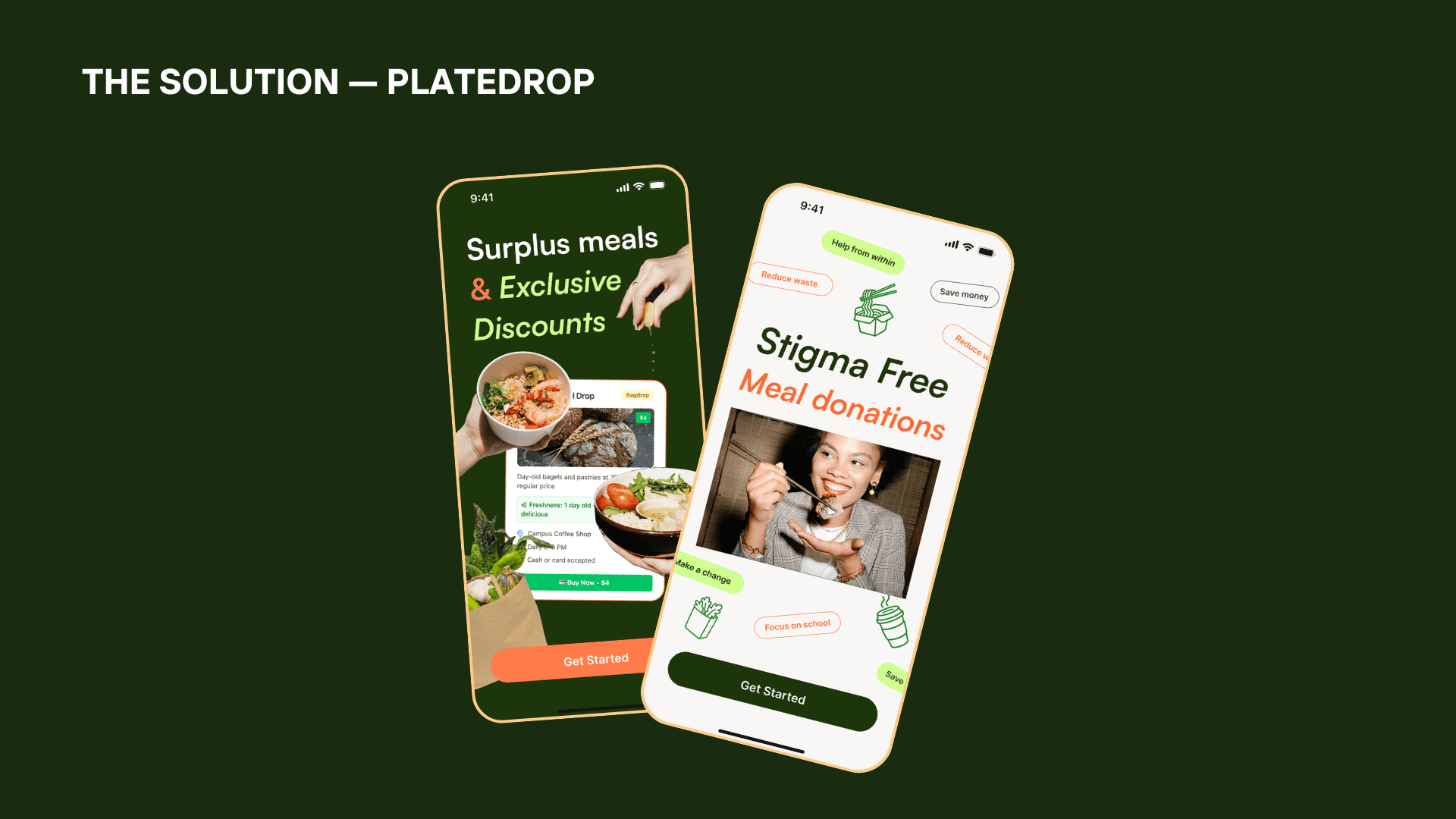
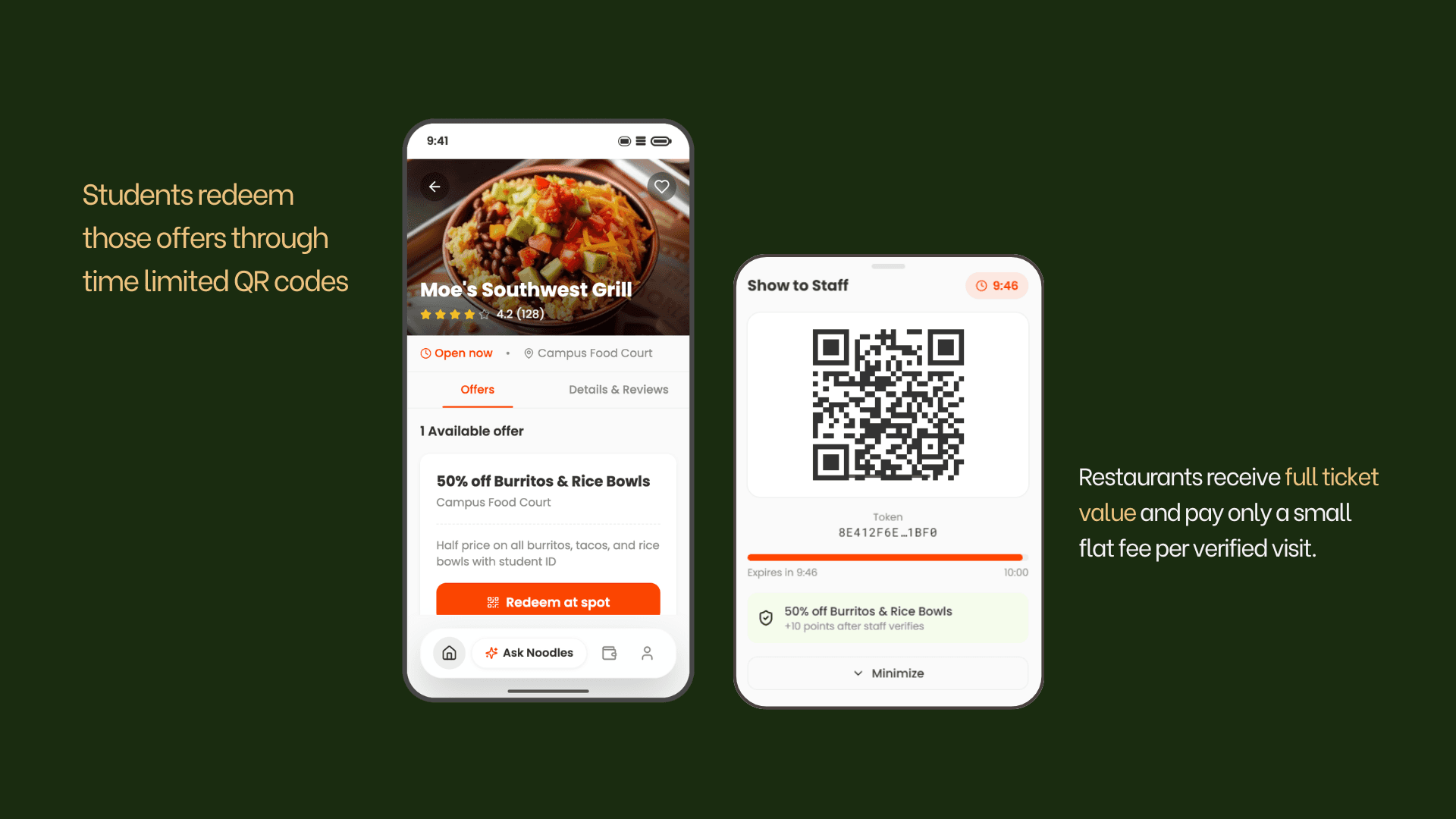
...where mission-driven brands fund meal credits that appear in student wallets, students redeem them through time-limited QR codes at real restaurants, and restaurants receive full ticket value.
...where mission-driven brands fund meal credits that appear in student wallets, students redeem them through time-limited QR codes at real restaurants, and restaurants receive full ticket value.
...where mission-driven brands fund meal credits that appear in student wallets, students redeem them through time-limited QR codes at real restaurants, and restaurants receive full ticket value.
Three audiences. One system. Zero friction between them.
Three audiences. One system. Zero friction between them.
Three audiences. One system. Zero friction between them.
MAIN FLOWS
MAIN FLOWS
MAIN FLOWS
Discovery
Discovery
Discovery
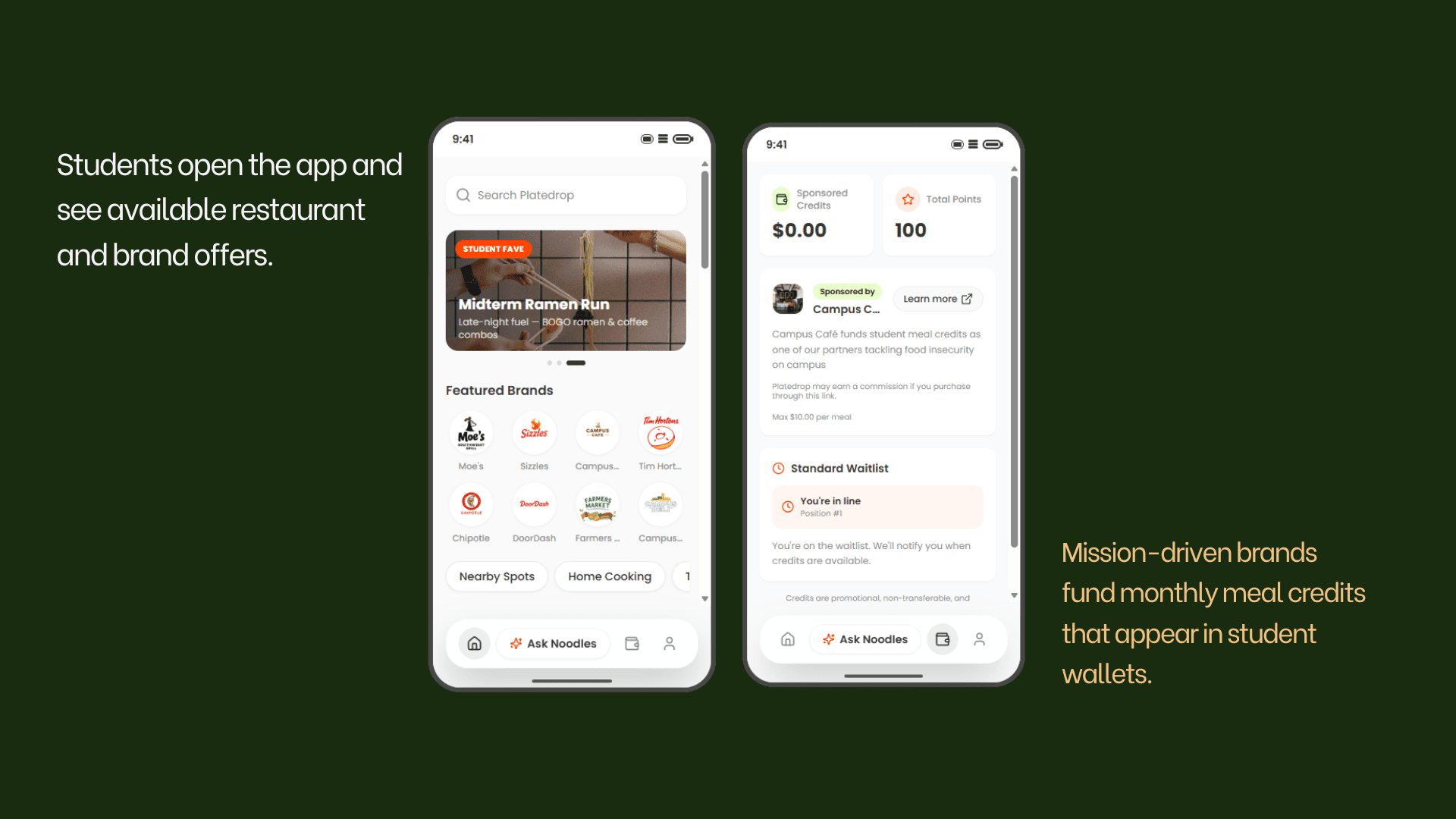
Students open the app and see available restaurant and brand offers — sorted by proximity, discount, and category.
Students open the app and see available restaurant and brand offers — sorted by proximity, discount, and category.
Students open the app and see available restaurant and brand offers — sorted by proximity, discount, and category.
Wallet & credits
Wallet & credits
Wallet & credits
Sponsored credits appear automatically. Students see who funded them and why — full transparency, no confusion.
Sponsored credits appear automatically. Students see who funded them and why — full transparency, no confusion.
Sponsored credits appear automatically. Students see who funded them and why — full transparency, no confusion.
Redemption
Redemption
Redemption
Students select an offer, generate a time-limited QR code, and show it to staff. Done in under 30 seconds.
Students select an offer, generate a time-limited QR code, and show it to staff. Done in under 30 seconds.
Students select an offer, generate a time-limited QR code, and show it to staff. Done in under 30 seconds.
Restaurant Foot-Traffic
Restaurant Foot-Traffic
Restaurant Foot-Traffic
Immediate predictability of student demand for restaurants, reducing waste before it even occurs
Immediate predictability of student demand for restaurants, reducing waste before it even occurs
Immediate predictability of student demand for restaurants, reducing waste before it even occurs
Impact Dashboard
Impact Dashboard
Impact Dashboard
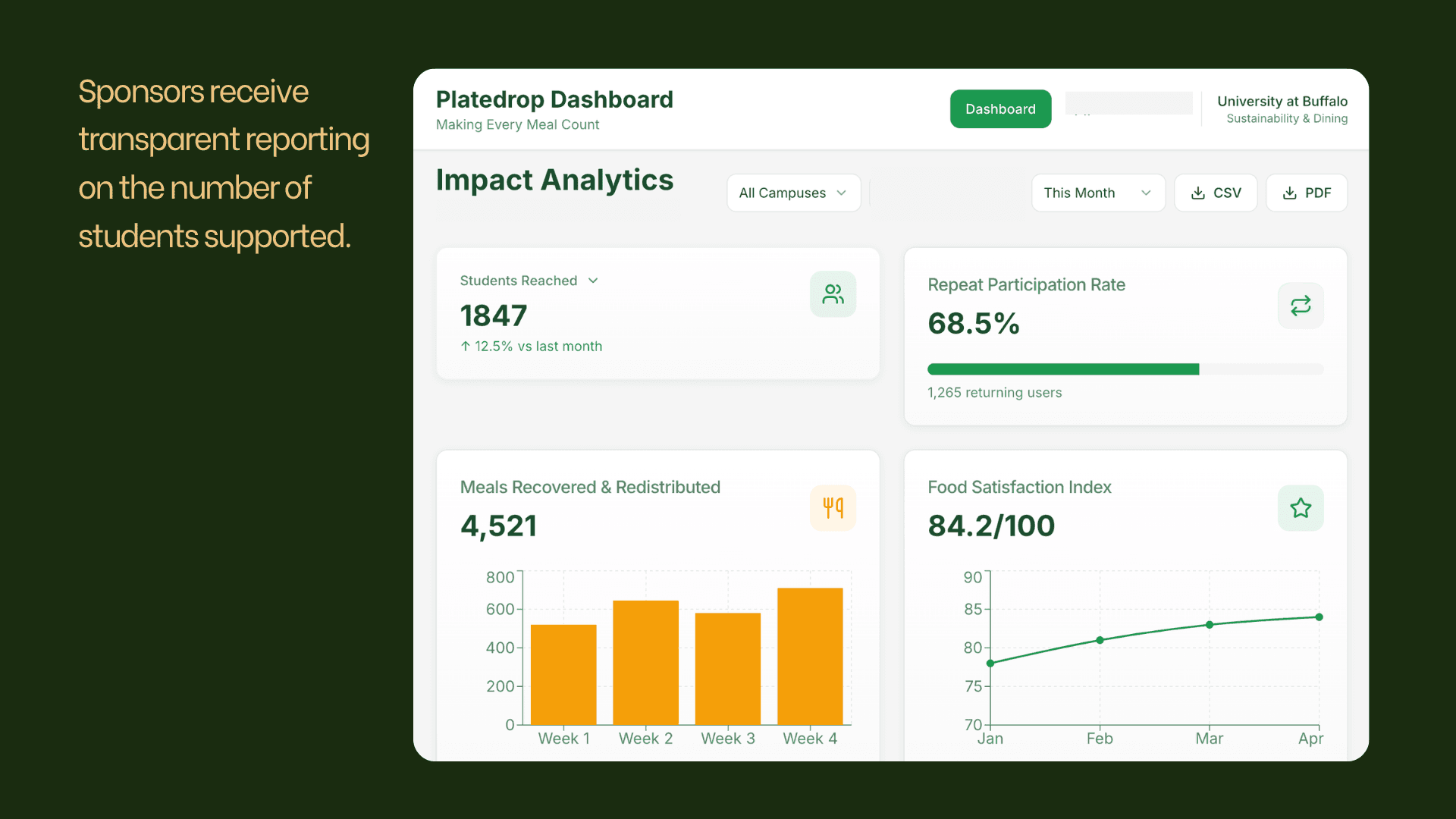
Sponsors receive transparent reporting on students reached, meals redistributed, repeat participation rate, and food satisfaction index — all in real time.
Sponsors receive transparent reporting on students reached, meals redistributed, repeat participation rate, and food satisfaction index — all in real time.
Sponsors receive transparent reporting on students reached, meals redistributed, repeat participation rate, and food satisfaction index — all in real time.
RESEARCH
RESEARCH
RESEARCH
The finding that changed everything: Students need a system that makes food affordable and provides help without creating stigma.
The finding that changed everything: Students need a system that makes food affordable and provides help without creating stigma.
The finding that changed everything: Students need a system that makes food affordable and provides help without creating stigma.
Meal-plan students (N=49):
Meal-plan students (N=49):
Meal-plan students (N=49):
30% skip meals due to dining-hour conflicts. 20% let meals go unused. 100% said they would donate if the system made it easy.
30% skip meals due to dining-hour conflicts. 20% let meals go unused. 100% said they would donate if the system made it easy.
30% skip meals due to dining-hour conflicts. 20% let meals go unused. 100% said they would donate if the system made it easy.
Non meal-plan students (N=26):
Non meal-plan students (N=26):
Non meal-plan students (N=26):
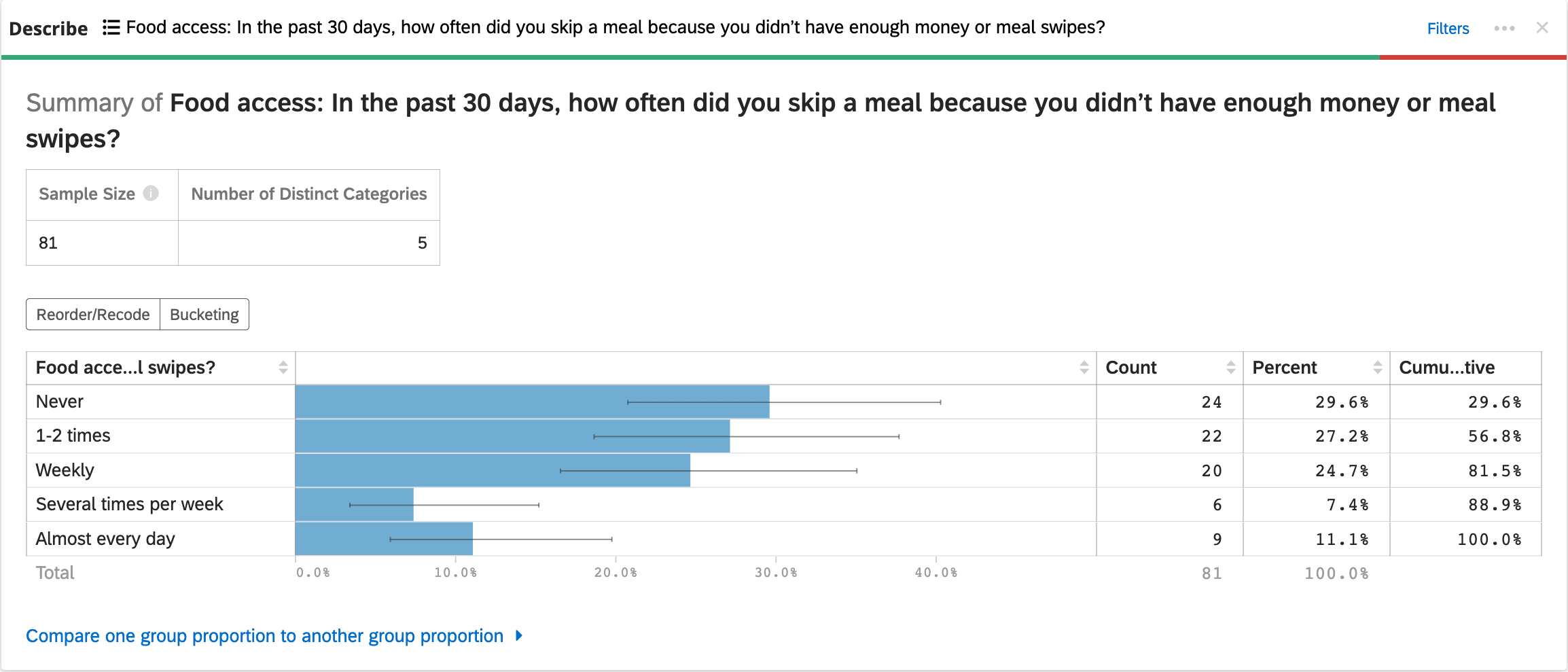
70% skip 3+ meals per week. 42% would accept anonymous help. 66% know about the food pantry but don't use it.
70% skip 3+ meals per week. 42% would accept anonymous help. 66% know about the food pantry but don't use it.
70% skip 3+ meals per week. 42% would accept anonymous help. 66% know about the food pantry but don't use it.
The pantry exists. Students won't use it. The problem isn't access. It's how access is designed.
The pantry exists. Students won't use it. The problem isn't access. It's how access is designed.
The pantry exists. Students won't use it. The problem isn't access. It's how access is designed.
Exploring Directions
Exploring Directions
Three existing models. None of them right.
Three existing models. None of them right.
Three existing models. None of them right.
SNAP
Built for the general public. Government-dependent. Requires proof of need that student life doesn't accommodate.
SNAP
Built for the general public. Government-dependent. Requires proof of need that student life doesn't accommodate.
SNAP
Built for the general public. Government-dependent. Requires proof of need that student life doesn't accommodate.
Too Good To Go
Surplus marketplace. No real-time access, no sponsor backing, no student-specific UX.
Too Good To Go
Surplus marketplace. No real-time access, no sponsor backing, no student-specific UX.
Too Good To Go
Surplus marketplace. No real-time access, no sponsor backing, no student-specific UX.
Campus Initiatives
Good intent. Scarce reach. Requires students to self-identify as needing help — which most won't do.
Campus Initiatives
Good intent. Scarce reach. Requires students to self-identify as needing help — which most won't do.
Campus Initiatives
Good intent. Scarce reach. Requires students to self-identify as needing help — which most won't do.
Why Platedrop?
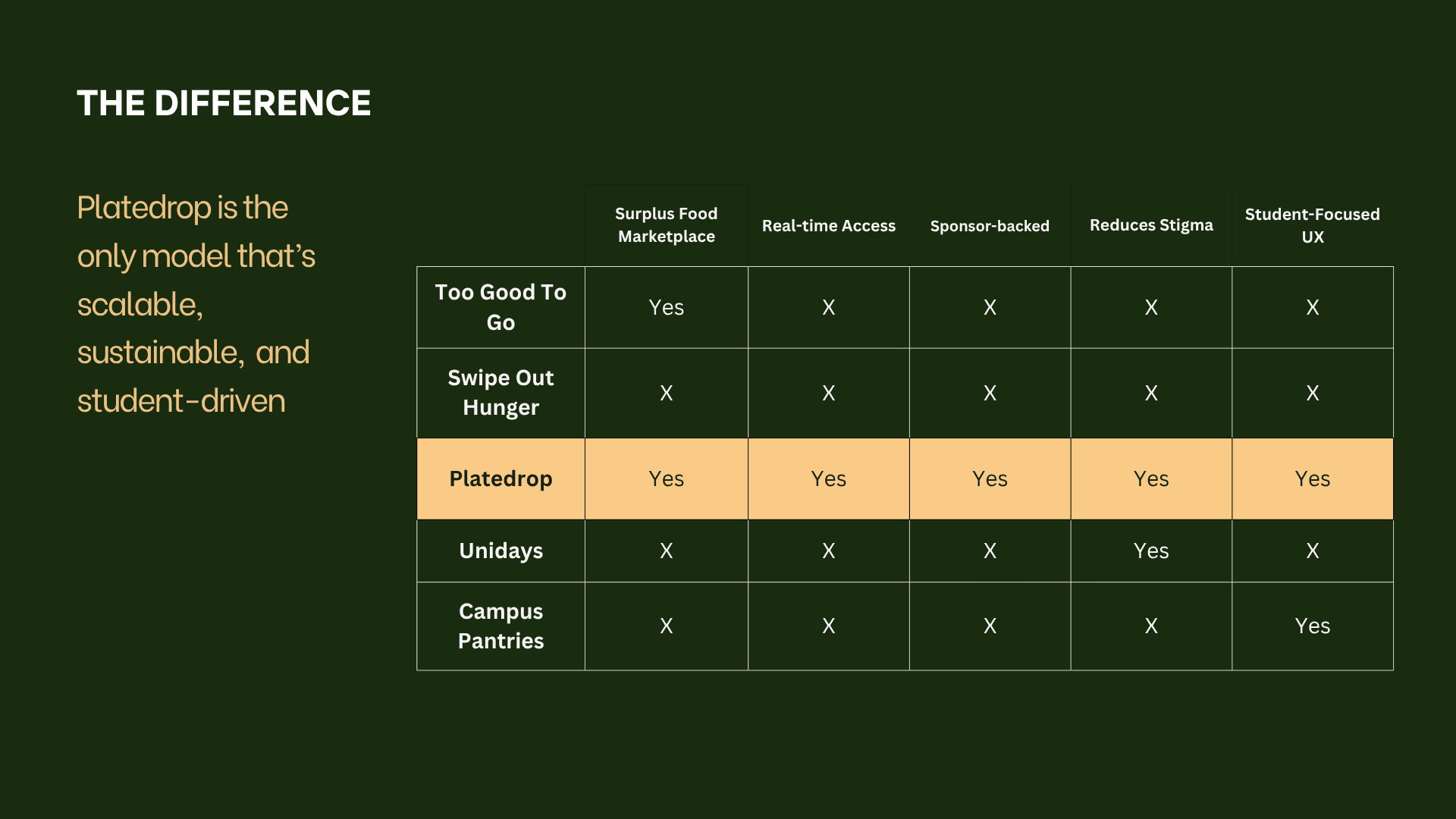
Platedrop is the only model with all five: surplus marketplace, real-time access, sponsor-backed, reduces stigma, student-focused UX
Why Platedrop?
Platedrop is the only model with all five: surplus marketplace, real-time access, sponsor-backed, reduces stigma, student-focused UX
Why Platedrop?
Platedrop is the only model with all five: surplus marketplace, real-time access, sponsor-backed, reduces stigma, student-focused UX
Enhances existing campus food infrastructure
Works with restaurants already on campus — not against their existing contracts.
Enhances existing campus food infrastructure
Works with restaurants already on campus — not against their existing contracts.
Enhances existing campus food infrastructure
Works with restaurants already on campus — not against their existing contracts.
Leverages brand ESG budgets
Mission-driven brands already spend on community impact. We give them a direct, measurable channel to students.
Leverages brand ESG budgets
Mission-driven brands already spend on community impact. We give them a direct, measurable channel to students.
Leverages brand ESG budgets
Mission-driven brands already spend on community impact. We give them a direct, measurable channel to students.
Easier to scale than donation models
No food handling. No logistics. No liability. Just a marketplace that routes existing food to students who need it.
Easier to scale than donation models
No food handling. No logistics. No liability. Just a marketplace that routes existing food to students who need it.
Easier to scale than donation models
No food handling. No logistics. No liability. Just a marketplace that routes existing food to students who need it.
THE PIVOT
THE PIVOT
THE PIVOT
We designed for donations first. Then reality pushed back.
We designed for donations first. Then reality pushed back.
We designed for donations first. Then reality pushed back.
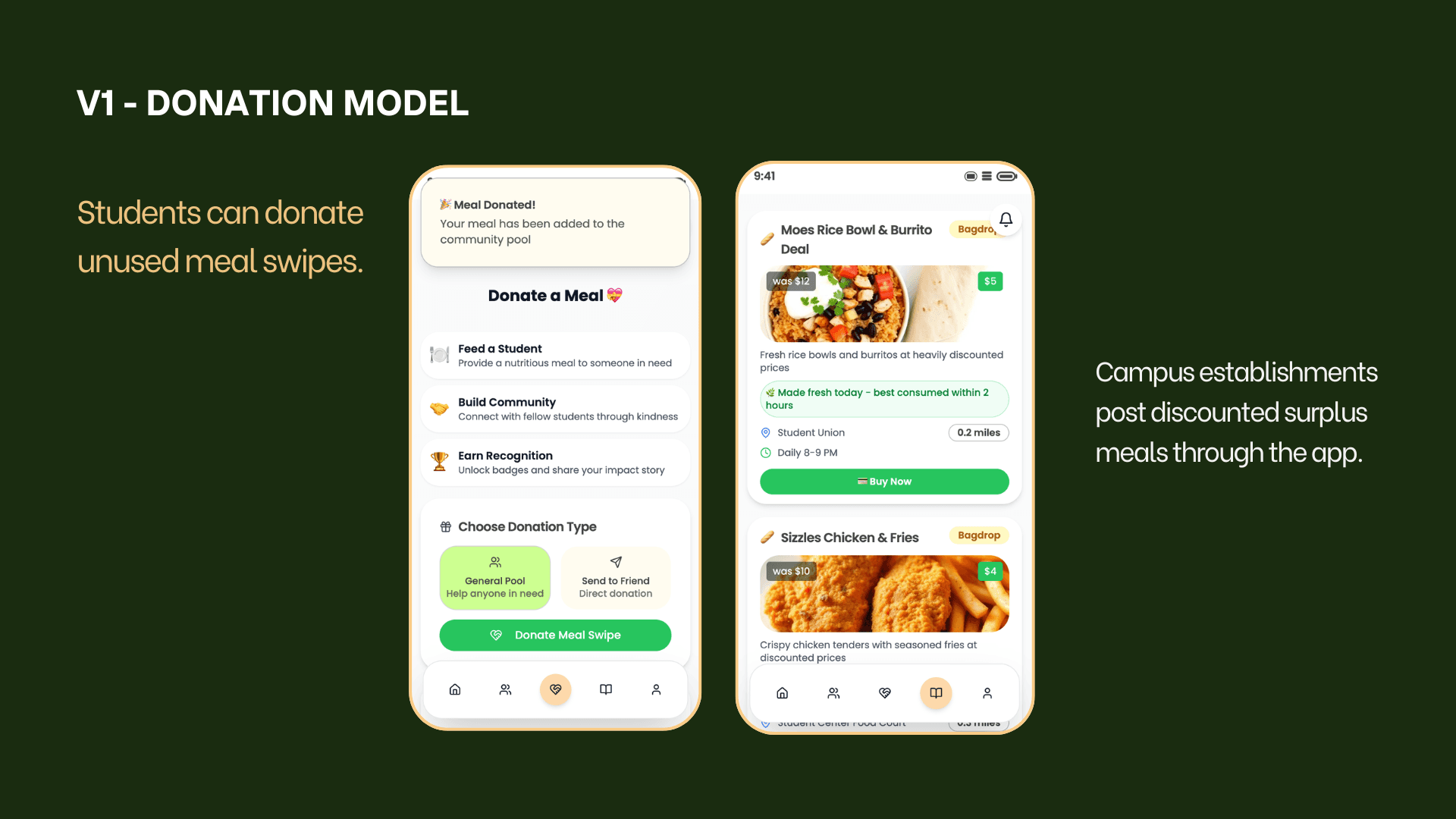
The original vision for Platedrop was built around meal swipe donations — students with unused swipes transferring them directly to students who needed them.
The original vision for Platedrop was built around meal swipe donations — students with unused swipes transferring them directly to students who needed them.
The original vision for Platedrop was built around meal swipe donations — students with unused swipes transferring them directly to students who needed them.
It made intuitive sense. 100% of meal-plan students said they would donate if the system made it easy. The willingness was there. The institution was not.
It made intuitive sense. 100% of meal-plan students said they would donate if the system made it easy. The willingness was there. The institution was not.
It made intuitive sense. 100% of meal-plan students said they would donate if the system made it easy. The willingness was there. The institution was not.
University dining contracts lock meal swipes to individual accounts.
They cannot be transferred, donated, or reassigned — by policy, by system architecture, and in many cases by legal agreement with third-party dining operators.
University dining contracts lock meal swipes to individual accounts.
They cannot be transferred, donated, or reassigned — by policy, by system architecture, and in many cases by legal agreement with third-party dining operators.
University dining contracts lock meal swipes to individual accounts.
They cannot be transferred, donated, or reassigned — by policy, by system architecture, and in many cases by legal agreement with third-party dining operators.
We also hit food safety liability walls around peer-to-peer food redistribution, and learned that campus pantry models — while well-intentioned — failed because they required students to self-identify as food insecure to use them.
We also hit food safety liability walls around peer-to-peer food redistribution, and learned that campus pantry models — while well-intentioned — failed because they required students to self-identify as food insecure to use them.
We also hit food safety liability walls around peer-to-peer food redistribution, and learned that campus pantry models — while well-intentioned — failed because they required students to self-identify as food insecure to use them.
So…we had to ask:
So…we had to ask:
So…we had to ask:
How do we build a system that helps students eat without requiring institutions to change their contracts — and without requiring students to ask for help?
How do we build a system that helps students eat without requiring institutions to change their contracts — and without requiring students to ask for help?
How do we build a system that helps students eat without requiring institutions to change their contracts — and without requiring students to ask for help?
The answer was the pivot. Instead of routing around the institution, we built alongside it. Instead of donation infrastructure that universities would block, we built a sponsor-backed discount marketplace that universities had no reason to oppose.
The answer was the pivot. Instead of routing around the institution, we built alongside it. Instead of donation infrastructure that universities would block, we built a sponsor-backed discount marketplace that universities had no reason to oppose.
The answer was the pivot. Instead of routing around the institution, we built alongside it. Instead of donation infrastructure that universities would block, we built a sponsor-backed discount marketplace that universities had no reason to oppose.
What we kept from the original vision:
Stigma-free access. Student-first UX. Real food at real campus vendors. A system that scales without depending on government funding.
What we kept from the original vision:
Stigma-free access. Student-first UX. Real food at real campus vendors. A system that scales without depending on government funding.
What we kept from the original vision:
Stigma-free access. Student-first UX. Real food at real campus vendors. A system that scales without depending on government funding.
What we let go:
Peer-to-peer transfer. Donation framing. Any feature that required institutional permission we couldn't get.
This is a trade-off we made deliberately. A working system that helps students today is worth more than a perfect system that never launches.
What we let go:
Peer-to-peer transfer. Donation framing. Any feature that required institutional permission we couldn't get.
This is a trade-off we made deliberately. A working system that helps students today is worth more than a perfect system that never launches.
What we let go:
Peer-to-peer transfer. Donation framing. Any feature that required institutional permission we couldn't get.
This is a trade-off we made deliberately. A working system that helps students today is worth more than a perfect system that never launches.
PROTOTYPING & TESTING
PROTOTYPING & TESTING
PROTOTYPING & TESTING
We are currently testing with real students at UB. Running the pilot with students on campus and observing how they move through the app — where they hesitate, what they skip, and whether the QR redemption would feel natural in a real restaurant setting.
We are currently testing with real students at UB. Running the pilot with students on campus and observing how they move through the app — where they hesitate, what they skip, and whether the QR redemption would feel natural in a real restaurant setting.
We are currently testing with real students at UB. Running the pilot with students on campus and observing how they move through the app — where they hesitate, what they skip, and whether the QR redemption would feel natural in a real restaurant setting.
Key Uver Insights
Key Uver Insights
Key Uver Insights
Stigma is invisible until the moment of use. Students who said they'd use the app hesitated when the redemption screen appeared in a public setting. The QR code had to feel indistinguishable from a loyalty app.
Sponsors need proof, not promises. Brands would not commit until we could show them a dashboard with real numbers. Impact reporting isn't a nice-to-have — it is the product that unlocksrevenue.
Design Decisions
We identified the most important design principle early and never let go of it. Stigma-free is not a feature. It's a constraint that shapes every single decision. Stigma-free is not a feature. It's a constraint that shapes every single decision.
Stigma is invisible until the moment of use. Students who said they'd use the app hesitated when the redemption screen appeared in a public setting. The QR code had to feel indistinguishable from a loyalty app.
Sponsors need proof, not promises. Brands would not commit until we could show them a dashboard with real numbers. Impact reporting isn't a nice-to-have — it is the product that unlocksrevenue.
Design Decisions
We identified the most important design principle early and never let go of it. Stigma-free is not a feature. It's a constraint that shapes every single decision. Stigma-free is not a feature. It's a constraint that shapes every single decision.
Stigma is invisible until the moment of use. Students who said they'd use the app hesitated when the redemption screen appeared in a public setting. The QR code had to feel indistinguishable from a loyalty app.
Sponsors need proof, not promises. Brands would not commit until we could show them a dashboard with real numbers. Impact reporting isn't a nice-to-have — it is the product that unlocksrevenue.
Design Decisions
We identified the most important design principle early and never let go of it. Stigma-free is not a feature. It's a constraint that shapes every single decision. Stigma-free is not a feature. It's a constraint that shapes every single decision.
Where we landed..,
Where we landed..,
Where we landed..,
The app cannot look like a food assistance program.
Discovery UI identical to any food app "Student Fave" badges. Featured brands. Category filters. Nearby Spots. Nothing that signals assistance unless a student looks for it.
Offers framed as exclusive deals — not donations "50% off Burritos & Rice Bowls" with student ID. Not "subsidized meal." Not "donated surplus." The framing removes the stigma entirely.
The app cannot look like a food assistance program.
Discovery UI identical to any food app "Student Fave" badges. Featured brands. Category filters. Nearby Spots. Nothing that signals assistance unless a student looks for it.
Offers framed as exclusive deals — not donations "50% off Burritos & Rice Bowls" with student ID. Not "subsidized meal." Not "donated surplus." The framing removes the stigma entirely.
The app cannot look like a food assistance program.
Discovery UI identical to any food app "Student Fave" badges. Featured brands. Category filters. Nearby Spots. Nothing that signals assistance unless a student looks for it.
Offers framed as exclusive deals — not donations "50% off Burritos & Rice Bowls" with student ID. Not "subsidized meal." Not "donated surplus." The framing removes the stigma entirely.
Sponsors need a return, not just a receipt.
Real-time impact reporting Students reached. Meals redistributed. Repeat participation rate. Food satisfaction index. Sponsors see exactly what their investment did — and come back.
Sponsors need a return, not just a receipt.
Real-time impact reporting Students reached. Meals redistributed. Repeat participation rate. Food satisfaction index. Sponsors see exactly what their investment did — and come back.
Sponsors need a return, not just a receipt.
Real-time impact reporting Students reached. Meals redistributed. Repeat participation rate. Food satisfaction index. Sponsors see exactly what their investment did — and come back.
Designing for Business Constraints
A marketplace with no revenue model is a charity. We needed it to be a business.
Designing for Business Constraints
A marketplace with no revenue model is a charity. We needed it to be a business.
Designing for Business Constraints
A marketplace with no revenue model is a charity. We needed it to be a business.
REFLECTION
REFLECTION
REFLECTION
Stigma is a design problem before it is anything else.
Stigma is a design problem before it is anything else.
Stigma is a design problem before it is anything else.
I knew students weren't using the food pantry. I assumed it was awareness. Research revealed it was shame. Those require completely different solutions — and if I had designed for awareness, I would have built the wrong product with the right intention.
A three-sided marketplace only works if all three sides feel like they win. Students need dignity. Restaurants need full ticket value. Sponsors need proof. The moment any one of those breaks down, the whole system stops working. Every design decision had to hold for all three — simultaneously.
I knew students weren't using the food pantry. I assumed it was awareness. Research revealed it was shame. Those require completely different solutions — and if I had designed for awareness, I would have built the wrong product with the right intention.
A three-sided marketplace only works if all three sides feel like they win. Students need dignity. Restaurants need full ticket value. Sponsors need proof. The moment any one of those breaks down, the whole system stops working. Every design decision had to hold for all three — simultaneously.
I knew students weren't using the food pantry. I assumed it was awareness. Research revealed it was shame. Those require completely different solutions — and if I had designed for awareness, I would have built the wrong product with the right intention.
A three-sided marketplace only works if all three sides feel like they win. Students need dignity. Restaurants need full ticket value. Sponsors need proof. The moment any one of those breaks down, the whole system stops working. Every design decision had to hold for all three — simultaneously.
Knowing when to build and when to design. Using Lovable to ship the app meant I could focus entirely on the experience decisions — what users see, how the system feels, where trust is built or broken — without getting blocked on engineering. The tool didn't replace design thinking. It removed everything that wasn't it.
Knowing when to build and when to design. Using Lovable to ship the app meant I could focus entirely on the experience decisions — what users see, how the system feels, where trust is built or broken — without getting blocked on engineering. The tool didn't replace design thinking. It removed everything that wasn't it.
Knowing when to build and when to design. Using Lovable to ship the app meant I could focus entirely on the experience decisions — what users see, how the system feels, where trust is built or broken — without getting blocked on engineering. The tool didn't replace design thinking. It removed everything that wasn't it.